
What Happened
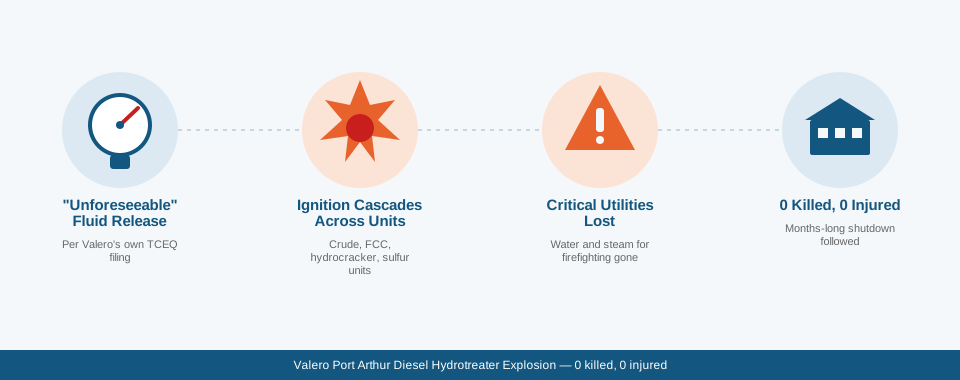
On the evening of March 23, 2026, a powerful explosion and fire struck the diesel hydrotreater unit, known as Unit 243 with a 47,000 barrel-per-day capacity, at Valero's Port Arthur, Texas refinery, one of the largest refining complexes on the Gulf Coast with a total capacity of approximately 435,000 barrels per day. The explosion was felt as far as 11 miles away and sent towering flames and thick black smoke into the sky, prompting a shelter-in-place order for the west side of Port Arthur and a strong sulfur smell reported by residents. In its subsequent filing with the Texas Commission on Environmental Quality, Valero reportedly described the cause as an "unforeseeable release of process fluid" in Complex 2, according to a secondhand characterization of that filing; this led to an ignition event and cascading upsets across major connected units, including the crude distillation unit, the fluid catalytic cracking (FCC) unit, the hydrocracker, and the sulfur recovery system. The initial detonation caused secondary fires to spread into the adjacent FCC unit, the core of the refinery's gasoline production. Containment efforts were severely hampered when the refinery's critical utilities, including the water and steam systems necessary for firefighting and for safely depressurizing other units, suffered a total loss, forcing operators to vent and flare large quantities of unstable hydrocarbons into the atmosphere, which further increased the risk of additional fires. Valero shut down the entire complex to prevent total facility loss. No injuries or fatalities were reported, and all personnel were accounted for. The Texas Department of Emergency Management and the Texas Commission on Environmental Quality deployed personnel and air monitoring equipment to the scene. The refinery experienced an extended shutdown, with only partial restart achieved by mid-April 2026 and the damaged hydrotreater and another crude line still under repair into the following spring and summer.
Root Causes
- An unforeseeable release of process fluid occurred in Complex 2, per Valero's own regulatory filing: this release was the initiating event, though the specific mechanical or procedural failure behind the release itself was not detailed in the company's public characterization.
- The ignition event triggered cascading upsets across multiple connected units: rather than remaining contained to the diesel hydrotreater, the disruption spread to the crude distillation unit, FCC unit, hydrocracker, and sulfur recovery system, indicating significant interdependency between these process areas.
- Critical utilities, including water and steam, were lost during the emergency response: this loss removed the resources needed both for firefighting and for safely depressurizing other units, directly limiting the response's effectiveness during the most critical period.
- Secondary fires spread into the adjacent FCC unit: the initial explosion's consequences extended beyond its unit of origin into the refinery's core gasoline-producing process, compounding the overall damage and extending the eventual repair and restart timeline.
Lessons Learned
- Critical utility systems like firefighting water and steam supply need resilience specifically designed to survive the initial event they may be most needed to respond to, since their total loss here directly hampered the ability to contain the explosion's consequences.
- Process unit interdependency needs explicit accounting in emergency response planning; a disruption originating in one unit cascading into crude distillation, FCC, hydrocracker, and sulfur recovery systems all at once suggests these connections deserve dedicated isolation and protection strategies.
- A company's own regulatory characterization of an incident as resulting from an "unforeseeable" release deserves careful independent scrutiny, since the retrospective determination of foreseeability often depends heavily on how thoroughly prior hazard analysis considered the actual failure mode that occurred.
- Extended refinery outages following a single unit's failure, as reflected in this incident's months-long path to full restart, illustrate the real economic and supply-chain consequences of insufficient unit-to-unit isolation, beyond the immediate safety concerns at the facility itself.