
What Happened
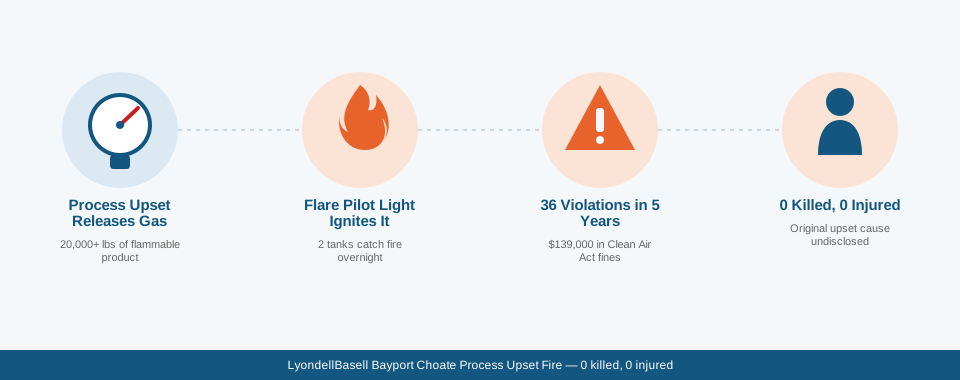
At approximately 7:45 to 9:00 p.m. on Thursday, March 12, 2026, a process upset occurred at LyondellBasell's Bayport Choate chemical plant in Pasadena, Texas, the world's largest producer of propylene oxide, propylene glycol, and related derivatives by production volume. The upset caused the release of flammable process gas, which activated the facility's emergency flare system; the released gas was then ignited by the flare's own pilot light, resulting in a visible fire involving two tanks that burned for several hours through the night. The Harris County Fire Marshal's Office, the La Porte and Pasadena Fire Departments, Channel Industries Mutual Aid, and Harris County HAZMAT and Pollution Control all responded to the scene. An initial company summary indicated the incident released more than 15,000 pounds of the highly flammable asphyxiant gas n-butane, along with large volumes of isobutane and carbon monoxide, with total flammable process gas involved exceeding 20,000 pounds. No injuries were reported, all personnel were accounted for, and air monitoring by Harris County Pollution Control found no actionable readings, with officials stating there was no off-site impact and no action needed from the surrounding community. The fire was fully extinguished by approximately 2:00 to 3:00 a.m., and control of the site was transitioned back to LyondellBasell. The specific cause of the initial process upset remained under investigation and was not publicly determined in the days following the incident. Subsequent reporting by ABC13 found that the Bayport facility had 36 instances of unauthorized air contaminant releases over the preceding five years according to Texas Commission on Environmental Quality records, and that LyondellBasell had been fined $139,000 for Clean Air Act violations at the site during that same period. Local environmental advocacy group Air Alliance Houston expressed concern both about the conditions leading to the incident and its air quality impact on surrounding communities.
Root Causes
- A process upset released flammable product into the facility's flare system: the underlying cause of this initial upset was not publicly determined, but it was severe enough to release over 20,000 pounds of flammable gas.
- The released gas was ignited by the flare system's own pilot light: rather than being safely combusted through the flare as intended, the volume or nature of the release resulted in ignition that spread to the visible tank fire, rather than controlled flaring.
- The facility had a documented recent history of air quality violations: 36 unauthorized emission releases and $139,000 in Clean Air Act fines over the preceding five years indicate this incident occurred at a site with an already established pattern of emissions control issues.
- The specific cause of the original upset was not publicly disclosed: as of the available reporting, the company and investigating authorities had not released a determination of what specifically triggered the process upset that led to the release.
Lessons Learned
- Flare systems are meant to safely combust released process gas in a controlled manner, and an incident where the flare's own pilot light instead ignites a broader fire suggests the volume or delivery of the release exceeded what the flare system was designed to safely handle.
- A facility's recent regulatory history, including unauthorized emission releases and Clean Air Act fines, is directly relevant context for evaluating any new safety incident at that site, since a pattern of prior violations may reflect underlying systemic issues rather than each incident being an isolated event.
- Prompt, specific public disclosure of a process upset's root cause supports both community trust and broader industry learning; when a facility's cause determination remains undisclosed well after an incident, affected communities and other operators of similar equipment lose the opportunity to understand and address the same risk.
- Community concern following an industrial fire, even one officials characterize as fully contained with no health impact, reflects a legitimate and predictable response given a facility's documented history, and should be treated as valid input deserving thorough, transparent follow-up rather than dismissed based on air monitoring results alone.