What Happened
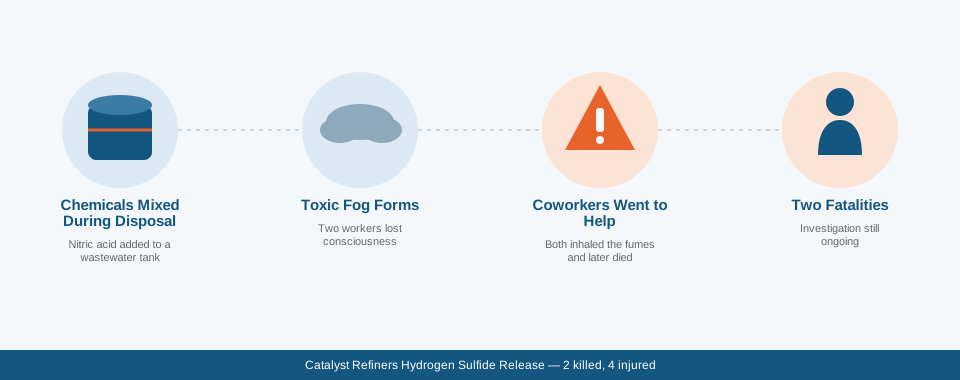
Catalyst Refiners, a facility that reclaimed silver from spent catalyst material, had ceased production and was in the process of decommissioning ahead of a planned closure. As part of disposing of chemicals still left on site, employees pumped a chemical solution into a wastewater receiving tank, then began adding diluted nitric acid into the same tank. Workers noticed a chemical reaction developing and fog forming over the tank; the employee operating the pump stopped adding acid and stepped outside for fresh air before losing consciousness. A supervisor who approached the tank to investigate also lost consciousness. Two other employees then went into the area to help their collapsed colleagues. Both inhaled the resulting hydrogen sulfide fumes and later died. The rescued supervisor survived. Emergency responders detected hydrogen sulfide at the scene and issued a shelter-in-place order for residents within a mile of the plant; 22 people, including four responders, were decontaminated on site, with roughly 18 transported to local hospitals for evaluation. Note on investigation status: as of this writing, CSB's investigation remains ongoing and no final report has been issued. This entry reflects CSB's August 2026 investigation update, not a completed root-cause analysis. Details may be revised once CSB's final report is published.
Root Causes (as identified so far)
- Incompatible chemicals mixed during ad hoc disposal: nitric acid and another chemical solution being disposed of through the wastewater system reacted to generate toxic hydrogen sulfide gas, a reaction CSB is still examining for exactly how the incompatibility went unrecognized.
- No written procedure for chemical disposal during decommissioning: CSB found the facility had no documented procedure specifying how leftover chemicals should be safely disposed of through the wastewater system.
- Respirators not required during decommissioning: workers told CSB that respirator use, which had presumably applied during active production, was no longer required once the facility transitioned to decommissioning. This was despite hazardous chemicals still being present and handled on site.
- Available respirators weren't equipped for the actual hazard: CSB found four full-face respirators at the facility, but none had filters rated to protect against hydrogen sulfide or similar toxic gases.
- No personal gas monitors provided: the company did not supply or require personal hydrogen sulfide monitors for employees or contractors, removing the layer of protection that could have warned workers before they were overcome.
Lessons Learned
- Facility decommissioning is not a lower-hazard phase of operation by default. CSB explicitly flagged that chemical inventories, operating conditions, and work activities can all still carry serious risk during shutdown, and safety requirements (respirators, gas monitors, written procedures) need to be reassessed for that phase specifically, not simply relaxed because production has stopped.
- Any point where two different chemicals are combined, even during routine disposal, needs a documented compatibility check beforehand; "we're just getting rid of this" is exactly the framing that can let a genuinely hazardous reaction go unanticipated.
- Protective equipment needs to be verified as matched to the actual hazard present, not just present in the building. Four respirators sitting on site provided no real protection once the specific gas involved required filters they didn't have.
- The instinct to help a collapsed coworker is powerful and, without proper training and equipment, extremely dangerous. This incident is a stark, recent example (echoing Foundation Food Group's nitrogen incident in this database) of rescuers becoming additional victims precisely because they weren't equipped to safely assess what they were walking into.