What Happened
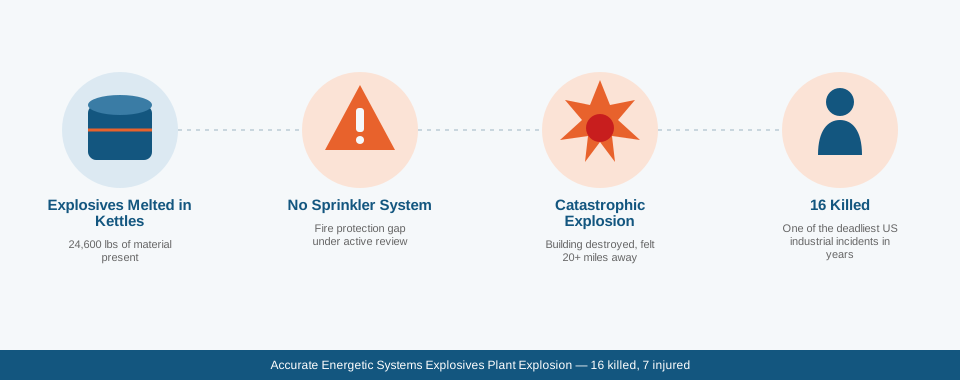
At approximately 7:47 a.m., multiple catastrophic explosions occurred inside Building 602 at the Accurate Energetic Systems (AES) explosives manufacturing facility, straddling the Hickman and Humphreys county line in rural Tennessee. At the time, AES was producing commercial explosive charges called cast boosters, a process that involves melting explosive material in agitated, steam-jacketed kettles. Investigators estimate roughly 23,000 pounds of explosive material detonated in the building, out of approximately 24,600 pounds present, with the remaining material recovered and safely disposed of on site afterward. The explosions completely destroyed Building 602 and launched debris up to 700 feet; the blast was reportedly felt more than 20 miles away and registered on seismic monitoring equipment. Sixteen employees were killed, one more was seriously injured, and six additional employees reported injuries, one of the deadliest industrial incidents in the United States in recent years. Because of the volume of undetonated explosive material scattered across the debris field, the ATF controlled access to the site for weeks before CSB investigators were able to begin their own work. Note on investigation status: as of this writing, CSB's investigation remains ongoing and no final report has been issued. This entry reflects CSB's March 2026 investigation update, not a completed root-cause analysis. Details, and likely additional findings, will be added once CSB's final report is published.
Root Causes (as identified so far)
- Explosive materials melted and mixed in production kettles: the incident occurred during the core production process, where explosive compositions were heated in agitated, steam-jacketed kettles. This is a process CSB is examining for how thermal, friction, or other sensitivity hazards may have been controlled or under-controlled.
- No sprinkler system in the building: CSB's investigation update specifically noted the absence of a sprinkler system in Building 602, a mechanical integrity and fire protection gap under active examination.
- A prior fatal incident at the same facility: media reports referenced an earlier explosion at AES roughly a decade before this one that also killed a worker, alongside a separate 2014 incident that killed one person and injured four others. This is a pattern CSB's investigation is expected to weigh alongside the current incident's causes.
- Investigation ongoing: CSB has not yet issued a determination of direct or root cause; the agency's public update explicitly frames the facts released so far as preliminary findings, not final conclusions.
Lessons Learned
- Facilities producing or handling explosive materials carry catastrophic-consequence potential by the nature of the product itself. Process steps involving heat, friction, or agitation of explosive compositions demand the most conservative possible engineering controls, since even a well-run process operates with very little margin for error.
- Fire protection systems (like sprinklers) are a basic mechanical integrity expectation for any facility handling combustible or explosive material. Their absence in a building actively processing 24,000+ pounds of explosives is a gap worth treating as urgent wherever else it might exist.
- A facility's own incident history, including fatalities from a decade or more earlier, deserves ongoing institutional memory and periodic hazard reassessment, not treatment as a closed chapter; CSB's interest in this facility's prior incidents reflects a recurring theme across this database (PCA DeRidder, Watson Grinding) where an earlier fatal event at the same site didn't fully translate into lasting prevention.
- This entry will be revisited and expanded once CSB's full investigation concludes. Readers researching this incident should check CSB's website directly for the most current findings, since the causal picture here is still actively developing.